Dedicated Storage vs Shared Storage Architectures: How Latency, Consistency, and Risk Actually Differ
What is shared storage architecture in modern cloud environments?
Shared storage architecture pools physical storage across multiple customers or workloads. Logical isolation separates tenants at the software layer, but the underlying hardware remains shared.
This model is efficient. It enables fast provisioning, lower upfront cost, and elastic growth. For development environments or non-critical workloads, that flexibility is often worth the tradeoff.
Under sustained load, performance depends on overall system activity. Disk controllers, I/O queues, and cache layers are shared. When demand spikes across tenants, latency can fluctuate. That variability is inherent to pooled infrastructure.
What is dedicated storage architecture and how is it different?
Dedicated storage assigns physical storage resources to a single tenant, which means no pooled arrays and no cross-customer contention.
The result is performance isolation. Latency behavior is driven by your workload alone, not by aggregate system activity.
This model prioritizes predictability over elasticity. It typically involves higher upfront commitment, but it reduces variability and simplifies troubleshooting, compliance documentation, and capacity planning.
While shared storage is built for flexibility, dedicated storage is built for control.
How does latency consistency impact databases and enterprise applications?
Latency consistency matters more than theoretical maximum IOPS.
When latency spikes occur unpredictably:
- Database commit times increase
- API response times fluctuate
- Autoscaling triggers unnecessarily
- Customer experience degrades
Even small latency jumps can cascade in systems with high concurrency.
For structured data workloads such as PostgreSQL, MySQL, Oracle, and SAP, block storage optimized for low-latency I/O is typically required.
HorizonIQ’s block storage can be delivered on hybrid or flash-based NVMe arrays, depending on tier. NVMe-based arrays reduce latency and improve stability under load.
For mission-critical systems, stability is more important than raw speed.
How do shared and dedicated storage architectures compare across operational dimensions?
| Dimension | Multi-Tenant Storage | Dedicated Storage |
| Hardware Allocation | Shared arrays | Exclusive arrays |
| Latency Stability | Variable under aggregate load | Stable and predictable |
| Noisy Neighbor Risk | Present | Eliminated across tenants |
| IOPS Control | Tier-based allocation | Full per-tenant allocation |
| Compliance Boundary | Logical isolation | Physical + logical isolation |
| Cost Model | Lower entry, scalable | Fixed capacity pricing |
| Best Fit | Dev/test, burst traffic | Production, regulated workloads |
This is typically where infrastructure teams realize the tradeoff is not technical preference. It is risk tolerance.
How does block storage differ from object storage in this discussion?
Dedicated vs shared architecture applies to both block and object storage, but the workload types differ.
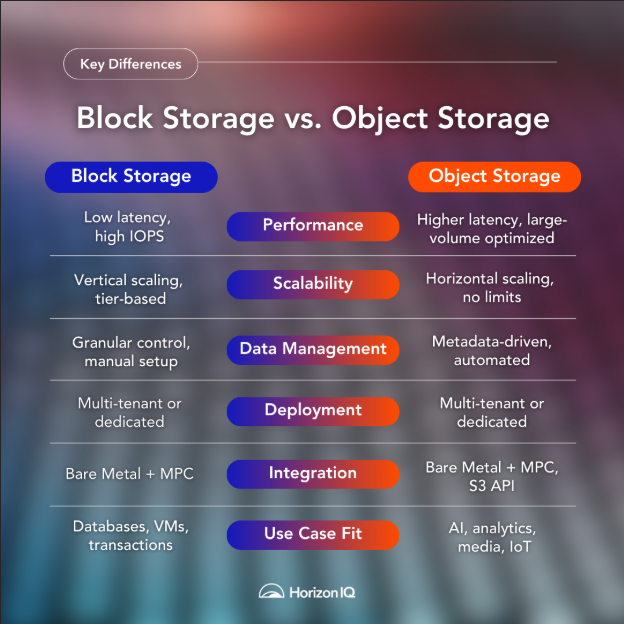
Block storage is optimized for structured data and low-latency I/O. It is typically used for:
- Databases
- Virtual machines
- Transactional systems
Block storage emphasizes granular control over IOPS and data placement.
Object storage is designed for large-scale unstructured data. It is typically used for:
- Data lakes
- AI training datasets
- Media files
- Backup archives
Object storage prioritizes horizontal scalability and metadata management.
For transactional systems, block storage remains the correct architectural choice. For scale-out analytics and AI pipelines, object storage often becomes foundational.
The key is not choosing one or the other. It is aligning the storage model to workload behavior.
How does storage architecture affect compliance and data sovereignty?
In regulated industries, auditors evaluate:
- Where data resides
- Who shares underlying infrastructure
- How isolation is enforced
- How encryption is implemented
Shared storage relies heavily on logical segmentation and provider-level guarantees.
Dedicated storage introduces physical resource isolation, which simplifies documentation and reduces ambiguity.
Physical isolation does not eliminate compliance requirements, but it reduces architectural complexity when demonstrating control boundaries.
For organizations subject to HIPAA, PCI DSS, GDPR, or SOC 2 audits, clarity of infrastructure ownership matters.
How does storage architecture influence cost predictability?
Shared storage environments often include:
- Usage-based billing
- IOPS tier scaling
- Performance throttling under burst limits
- Variable cost profiles
As workloads grow, billing behavior changes.
Dedicated storage environments typically use capacity-based pricing. Once provisioned, performance characteristics and cost profiles remain stable.
For finance leaders, predictable infrastructure spend reduces planning friction.
Storage architecture decisions often surface first in billing reviews, not performance dashboards.
When should you choose shared storage vs dedicated storage?
The decision usually comes down to workload maturity and risk tolerance.
Shared storage is often appropriate in earlier-stage or lower-risk environments. Dedicated storage becomes more compelling as systems become revenue-critical, compliance-bound, or performance-sensitive.
Here’s how the decision typically breaks down:
| Scenario | Shared Storage Makes Sense | Dedicated Storage Makes Sense |
| Workload Stage | Early-stage or experimental | Mature, production-grade |
| Traffic Pattern | Unpredictable or bursty | Steady and sustained |
| Performance Sensitivity | Low impact if latency fluctuates | Latency spikes affect users or revenue |
| Compliance Requirements | Minimal regulatory oversight | Frequent audits or strict data controls |
| AI / Analytics Workloads | Occasional or exploratory | Continuous, throughput-sensitive pipelines |
| Operational Stability | Minor performance variance acceptable | Instability triggers escalation or scaling |
| Budget Model | Minimal upfront commitment preferred | Predictable monthly infrastructure spend prioritized |
If performance variability is tolerable and workloads are still evolving, shared storage offers flexibility.
If latency instability is driving reactive scaling, customer complaints, or audit friction, storage architecture should be examined before adding more compute.
Compute is often blamed, but storage is frequently the bottleneck.
How can organizations balance flexibility and performance?
Most mature environments adopt a tiered approach:
- Dedicated block storage for transactional systems
- Scalable object storage for analytics and AI
- Clear isolation boundaries for production workloads
The goal is not maximal performance everywhere. It is predictable performance where it matters.
Providers that support both block and object storage in multi-tenant and single-tenant configurations allow organizations to evolve architecture as workloads mature.
For teams evaluating storage options, reviewing available block and object storage models within a managed private infrastructure environment can clarify which architecture aligns best with current operational risk and growth plans.
What is the practical takeaway for infrastructure decision-makers?
Shared storage optimizes for speed of deployment and lower initial cost. Dedicated storage optimizes for consistency, compliance clarity, and predictable behavior under load.
As infrastructure matures and workloads become revenue-critical, variability becomes more expensive than capacity.
Storage architecture is rarely the first decision revisited, but it is often the one that stabilizes everything else.