
Beyond VMware: How to Build a Smarter Infrastructure Strategy for What’s Next
The conversation around VMware has shifted dramatically over the past two years. Following Broadcom’s acquisition, many organizations are rethinking long-standing virtualization strategies as licensing changes, rising costs, and uncertainty reshape infrastructure planning.
The instinct is often to ask a simple question: What should replace VMware?
According to infrastructure experts working with organizations through these transitions every day, that’s the wrong place to start.
Choosing a new hypervisor is only one piece of a successful migration puzzle. Long-term success depends on building an infrastructure strategy that strengthens resilience, supports business goals, and gives IT teams greater flexibility over the next three to five years.
That was a consistent theme throughout the Beyond VMware: Practical Paths Forward After Broadcom webinar, where experts from Summit and Veeam shared lessons from real migration projects.
Why are organizations reevaluating VMware now?
Licensing costs may have sparked the conversation, but they’re rarely the only factor.
Many IT leaders are using this moment to revisit infrastructure decisions that have accumulated over years of growth, acquisitions, and changing business priorities.
Common drivers include:
- Higher and less predictable licensing costs
- Pressure to improve budget forecasting
- Vendor lock-in concerns
- Growing demands for disaster recovery and cyber resilience
- Expanding hybrid cloud and AI workloads
- Aging infrastructure that no longer aligns with current business needs
For many organizations, VMware simply became the catalyst for a broader modernization initiative.
Why shouldn’t VMware replacement start with choosing a hypervisor?
One of the strongest messages from the webinar was that infrastructure decisions should begin with operations, not technology.
Before evaluating platforms, organizations should ask:
- Which applications are most critical to the business?
- What service levels do those applications require?
- Which workloads belong on dedicated infrastructure?
- Which workloads benefit from public cloud scalability?
- Where does compliance require workload isolation?
- How much operational complexity can the IT team realistically support?
These questions help prevent a common mistake: migrating existing technical debt onto a new platform.
A VMware migration is an opportunity to redesign infrastructure around business outcomes instead of recreating yesterday’s environment.
How should organizations evaluate VMware alternatives?
Every environment is different, which is why there is rarely a single replacement for every workload.
Instead of comparing hypervisors alone, evaluate each option across operational requirements.
| Evaluation area | Questions to consider |
| Cost predictability | Can budgets be forecast over the next 3–5 years? |
| Operational complexity | Does the platform match existing team skills? |
| Disaster recovery | How easily can backup and recovery integrate? |
| Scalability | Will infrastructure support future growth and AI initiatives? |
| Security & compliance | Does the platform support isolation and governance requirements? |
| Vendor flexibility | Does it reduce long-term lock-in? |
Organizations with mixed environments often find that different workloads belong on different platforms, including dedicated infrastructure, managed private cloud, or public cloud services.
This workload-first approach also supports future cloud repatriation efforts as organizations balance cost, performance, and operational control.
What role does managed private cloud play after VMware?
For many businesses, the goal isn’t simply replacing virtualization software. It’s reducing operational burden while maintaining control over critical infrastructure.
That’s where managed private cloud becomes an attractive option.
Rather than managing every layer internally, organizations can leverage dedicated infrastructure backed by proactive monitoring, cloud-certified engineers, and predictable operating costs.
HorizonIQ’s Managed Private Cloud is designed around these priorities, providing:
- Single-tenant infrastructure for performance isolation
- Redundant architecture for high availability
- Multi-layer security protections
- 24/7 infrastructure management
- Centralized operational visibility
- Infrastructure that scales alongside business growth
For organizations that still require dedicated environments while reducing day-to-day management responsibilities, this model offers a practical middle ground.
Why should disaster recovery be part of every migration plan?
Migration projects naturally focus on moving workloads. The webinar panel encouraged organizations to think bigger.
Infrastructure transitions provide an ideal opportunity to strengthen:
- Backup validation
- Disaster recovery planning
- Ransomware resilience
- Recovery testing
- Documentation
- Operational standardization
Rather than treating disaster recovery as a separate project later, organizations can improve resilience during the migration itself.
This approach reduces future risk while avoiding duplicate implementation efforts.
What’s the safest way to migrate away from VMware?
One misconception is that migrations should happen as one large “lift and shift.”
Experienced migration teams generally recommend a phased approach.
Successful projects often include:
- Assess existing workloads.
- Identify application dependencies.
- Pilot low-risk systems first.
- Validate backup and recovery.
- Migrate in controlled waves.
- Test thoroughly before expanding.
Starting with development, QA, or other lower-risk workloads gives IT teams the opportunity to refine processes before moving business-critical applications.
This measured approach also limits disruption while building confidence across stakeholders.
What can organizations learn from real VMware migration projects?
One customer example discussed during the webinar was Romanoff Innovations.
Rather than rushing to replace infrastructure, the project focused on phased migration, workload assessment, stakeholder alignment, and continuous validation throughout the process.
The result was a controlled migration that minimized disruption while creating opportunities to strengthen disaster recovery and operational processes along the way.
For organizations considering a move to Hyper-V Private Cloud, our parent company Summit has also published a detailed case study showing how Romanoff successfully modernized its virtualization environment using a structured migration strategy.
The broader lesson extends beyond any single platform.
Organizations that spend more time planning tend to spend less time recovering from avoidable surprises.
How does hybrid cloud fit into a post-VMware strategy?
Many organizations no longer operate entirely on-premises or entirely in public cloud.
Instead, they’re building hybrid environments that allow workloads to live where they make the most operational and financial sense.
A modern hybrid strategy allows teams to:
- Keep sensitive workloads on private infrastructure
- Burst into public cloud during peak demand
- Support AI and GPU-enabled workloads efficiently
- Improve cost transparency
- Reduce architectural redesign as requirements evolve
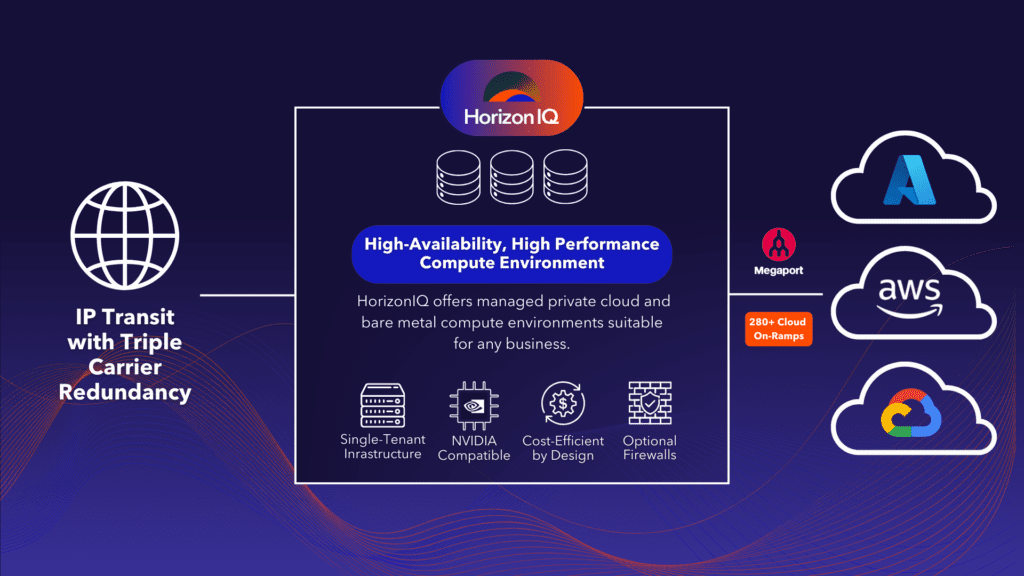
HorizonIQ Connect supports this approach by securely connecting private infrastructure with major public cloud providers while maintaining centralized management and predictable operations.
For organizations planning beyond today’s migration, hybrid flexibility may become one of the most valuable long-term outcomes.
What does a successful post-VMware strategy look like?
Organizations that emerge strongest from this transition typically share a few characteristics.
They focus on:
- Business outcomes before technology choices
- Operational simplicity alongside technical capability
- Predictable infrastructure costs
- Resilient disaster recovery practices
- Flexible workload placement
- Infrastructure that supports future AI, cloud, and growth initiatives
Most importantly, they view VMware’s disruption as an opportunity to modernize, rather than simply replace software.
That perspective creates room for stronger governance, improved resilience, and infrastructure decisions that continue delivering value long after the migration is complete.
Whether you’re evaluating managed private cloud, hybrid cloud, or alternative virtualization platforms, the objective remains the same: build an infrastructure strategy that supports where your business is going next, not where it has been.
Editor’s note: Summit is the parent company of HorizonIQ and specializes in VMware to Hyper-V migrations and managed Hyper-V private cloud solutions. We’ve included Summit resources throughout this article where they provide additional guidance for organizations evaluating their next steps.