
Kubernetes gives teams a consistent way to deploy, scale, and manage containerized applications across infrastructure environments. Where that infrastructure runs can have a major impact on performance, cost, security, and operational complexity.
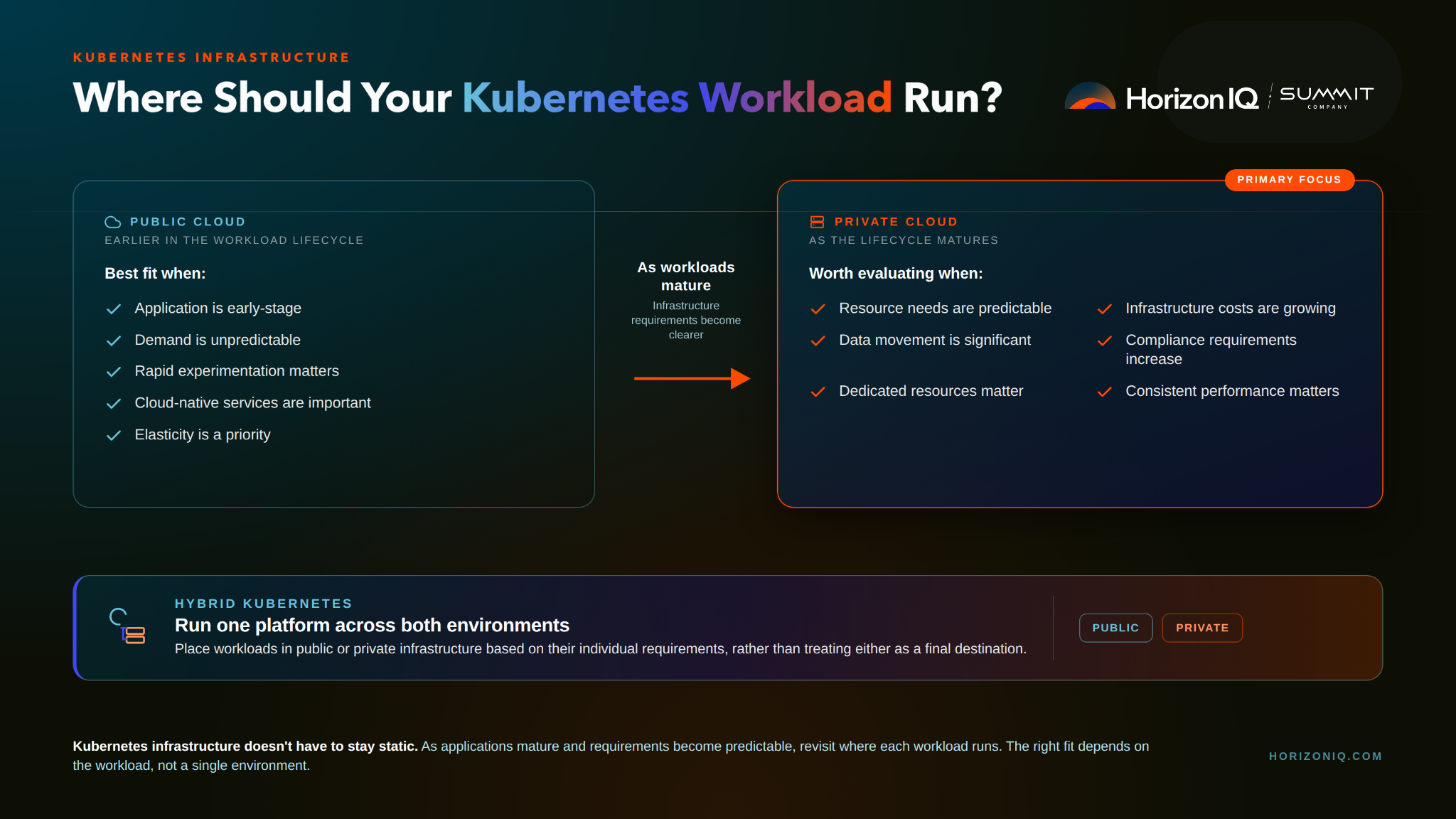
For many organizations, public cloud Kubernetes is a logical starting point. It offers fast provisioning, elastic capacity, and integrations with cloud-native services. As workloads mature, the equation can change. Stable utilization, growing data volumes, compliance requirements, specialized hardware, and unpredictable cloud bills can make Kubernetes on private cloud worth evaluating.
The useful question is whether dedicated infrastructure better fits the economics and operational requirements of the workloads Kubernetes is orchestrating.
What is Kubernetes on private cloud?
A Kubernetes private cloud deployment runs Kubernetes clusters on infrastructure reserved for a single organization.
The underlying environment can take several forms:
- Kubernetes running in virtual machines on a private cloud
- Worker nodes running directly on bare metal servers
- Virtualized control-plane nodes combined with physical worker nodes
- Hybrid environments connecting private Kubernetes infrastructure with public cloud resources
We previously explored both Kubernetes on Proxmox and Kubernetes deployed on bare metal. These architectures illustrate how Kubernetes can be deployed across different infrastructure models depending on the requirements of the workload.
When does Kubernetes on private cloud make sense?
Private cloud Kubernetes becomes particularly relevant once applications move beyond early experimentation and infrastructure requirements become easier to characterize.
When workloads have stable resource utilization
Public cloud is valuable when demand changes rapidly or remains uncertain. Once applications establish predictable baselines, continually paying metered compute, storage, and network costs deserves another look.
Private infrastructure allows teams to size dedicated capacity around sustained demand and work from a more predictable cost base. That can be attractive for mature SaaS platforms, high-volume APIs, CI/CD environments, data processing systems, persistent services, and AI inference workloads.
When consistent performance matters
Kubernetes can reschedule workloads when nodes fail, but orchestration cannot eliminate every infrastructure bottleneck.
Dedicated infrastructure provides greater control over CPU, memory, storage performance, networking, and hardware configuration. Teams can also incorporate GPU-enabled nodes, high-memory systems, fast local storage, or specific network configurations into the cluster architecture.
For sustained, performance-sensitive workloads, that control can translate into more consistent application behavior.
When compliance or data control becomes more demanding
Regulated organizations may need tighter control over where data resides, who can access infrastructure, and how systems are isolated.
Kubernetes controls such as RBAC, network policies, and secrets management remain essential. Single-tenant private infrastructure adds physical and operational isolation underneath the Kubernetes layer.
That can be useful for healthcare, financial services, government, and other environments with strict compliance or data sovereignty requirements.
When network and egress costs become material
Kubernetes applications communicate with databases, storage, APIs, analytics systems, users, and other clusters.
For data-intensive applications, public cloud network and egress charges can become a meaningful part of the infrastructure bill. Keeping frequently communicating services on dedicated infrastructure can make those costs easier to model.
Key takeaway: Private cloud Kubernetes becomes more compelling as workloads become mature, sustained, data-intensive, compliance-sensitive, or dependent on specialized infrastructure.
How does private cloud Kubernetes compare with public cloud Kubernetes?
| Consideration | Public Cloud Kubernetes | Private Cloud Kubernetes |
| Initial deployment | Usually faster | Requires more planning |
| Capacity | Highly elastic | Dedicated, planned capacity |
| Costs | Usage-based and variable | More predictable |
| Hardware | Provider-defined options | Greater configuration control |
| Isolation | Logical isolation on provider infrastructure | Single-tenant options |
| Data location | Available provider regions | Greater placement control |
| Network costs | Egress and usage charges may apply | Easier to model for sustained traffic |
| Operations | Provider manages some Kubernetes components | Self-managed or managed by infrastructure partner |
| Strong fit | New or highly variable workloads | Mature, steady, regulated, specialized workloads |
A hybrid model can also make sense. Organizations can keep predictable production workloads on private infrastructure while using public cloud capacity for development, temporary demand, geographic expansion, or specialized services.
Should Kubernetes run on private cloud VMs or bare metal?
Both are technically viable, and the choice depends on the workload.
Virtual machines are a strong fit for many production deployments because they simplify provisioning, resource allocation, backup, and infrastructure lifecycle management. Our Kubernetes on Proxmox guide examines how Kubernetes can be deployed on virtualized private cloud infrastructure.
Bare metal Kubernetes becomes attractive when workloads need dedicated compute, high-throughput networking, specialized hardware, or highly predictable performance. Summit offers dedicated bare metal infrastructure for this deployment model, while our bare metal Kubernetes deployment guide covers the underlying architecture in more detail.
Some environments use both, with virtualized control-plane nodes and bare-metal workers supporting applications with different infrastructure requirements.
What does operating private cloud Kubernetes require?
Moving Kubernetes to private infrastructure gives teams more control over the environment, but it also means someone needs to manage the cluster lifecycle.
Production Kubernetes requires ongoing attention to high availability, networking, persistent storage, monitoring, backups, security patches, upgrades, scaling, and incident response. For lean infrastructure teams, those responsibilities can influence whether private cloud is operationally practical.
Managed Kubernetes is one way to address that gap. Summit’s Managed Kubernetes runs on single-tenant infrastructure with dedicated worker nodes and supports private, public, and hybrid or multi-cloud deployments. Summit manages the control plane and infrastructure operations, including provisioning, patching, upgrades, scaling, monitoring, and security, while customers retain responsibility for their applications and deployments.
This separation allows organizations to pursue dedicated Kubernetes infrastructure without requiring their internal team to own every layer of cluster operations.
How can Kubernetes fit into a private or hybrid cloud strategy?
Private infrastructure gives organizations several ways to place Kubernetes workloads based on their actual requirements.
HorizonIQ’s Managed Private Cloud is built around single-tenant infrastructure, scalable compute and storage, redundant architecture, centralized management, and hands-on engineering support. Those capabilities align with organizations evaluating Kubernetes private infrastructure for performance, compliance, cost predictability, or greater infrastructure control.
For organizations that still need hyperscaler services or elastic capacity, a hybrid strategy can keep predictable Kubernetes workloads on private infrastructure while using public cloud resources for temporary demand, geographic requirements, or specialized services.
The result is greater flexibility to place workloads according to their performance, security, cost, and scaling requirements.
How do you know when it is time to evaluate Kubernetes private cloud?
Private cloud deserves serious consideration when several of these conditions are true:
- Kubernetes utilization has become reasonably predictable.
- Public cloud infrastructure or network costs are growing materially.
- Applications require consistent performance or specialized hardware.
- Compliance, data residency, or isolation requirements have increased.
- Large volumes of data move between services.
- The organization wants greater control over infrastructure architecture.
- The internal team has a plan for managing Kubernetes operations, internally or through a managed provider.
For early applications with uncertain demand, public cloud Kubernetes may remain the most practical option.
As applications mature, Kubernetes on private cloud can provide a more deliberate foundation for predictable workloads. Dedicated infrastructure gives teams greater control over capacity, performance, security, and costs.
The private cloud conversation becomes worth having when you understand the workload well enough to build the infrastructure around what it needs.