
Proxmox Subscription & Pricing Guide: What a Production Deployment Can Cost
Proxmox VE has become one of the leading virtualization alternatives for organizations reconsidering VMware following Broadcom’s acquisition. The software is open-source and free to download, which is where most articles end. Real production spend looks nothing like the free download page.
This guide walks through what a Proxmox subscription actually costs in 2026, how the per-socket licensing works in practice, what Proxmox Backup Server adds on top, and what a realistic three-node cluster runs per year once you include hardware, storage, backup, and staff time.
We also show how Proxmox pricing stacks up against VMware vSphere Standard under Broadcom’s new per-core subscription model. At the end, we’ll discuss how HorizonIQ’s Managed Private Cloud folds all of it into a single monthly line item.
Is Proxmox VE actually free?
Yes. Proxmox Virtual Environment is free and open-source software released under the GNU AGPLv3 license.
You can download Proxmox VE, install it on unlimited hardware, and use it commercially or in production without paying Proxmox Server Solutions GmbH. The free version includes the complete virtualization feature set, including:
- High availability
- Live migration
- Clustering
- Ceph integration
- Snapshots
- KVM virtual machines
- LXC containers
A paid subscription does not unlock additional virtualization features. Instead, it provides access to Proxmox’s Enterprise Repository and, depending on the subscription level, direct technical support from Proxmox.
Without a subscription, you cannot use the Enterprise Repository or open support tickets directly with Proxmox.
You can still receive updates through the public no-subscription repository, but Proxmox describes that repository as more frequently updated and less extensively tested than its Enterprise Repository. Proxmox recommends the Enterprise Repository for production environments.
What does a Proxmox subscription actually get you?
Every paid Proxmox VE subscription includes access to the Proxmox VE Enterprise Repository and the complete Proxmox VE feature set. Basic, Standard, and Premium add direct support through the Proxmox Customer Portal and access to the Proxmox Datacenter Manager Enterprise Repository and support. Standard and Premium also include remote SSH support and offline subscription-key activation.
The Community tier gets updates but no ticket entitlement. Basic, Standard, and Premium each buy progressively more tickets and a tighter first-response SLA. None of the tiers cap features, socket counts, or cluster size. The tier only changes support economics, not what the software can do.
How much does each Proxmox VE subscription tier cost?
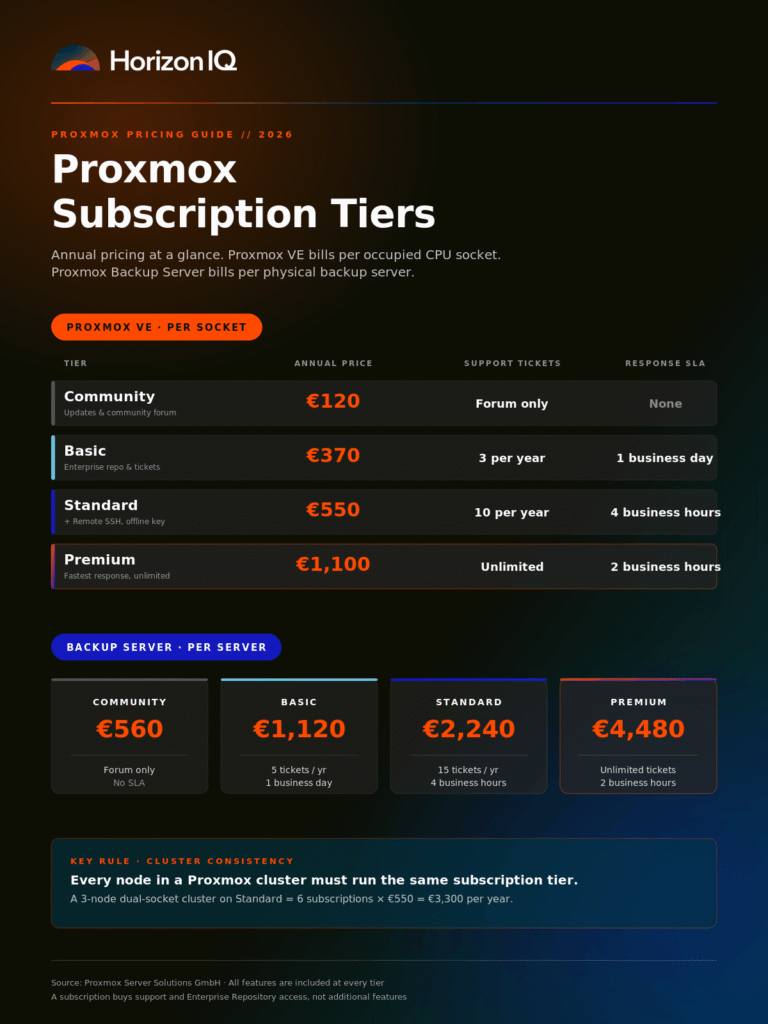
Proxmox offers four subscription tiers. Each is priced per occupied physical CPU socket, per year.
Tier |
Price (EUR) | Price (USD *) | Support tickets/yr | Response SLA |
|---|---|---|---|---|
Community |
€120 | $137 | Community forum only | None |
Basic |
€370 | $423 | 3 | 1 business day |
Standard |
€550 | $628 | 10 | 4 business hours |
Premium |
€1,100 | $1,257 | Unlimited | 2 business hours |
*USD estimates use the European Central Bank reference rate of €1 to approximately $1.1426 published on July 20, 2026. Exchange rates fluctuate.
All prices are net; VAT applies where relevant. The subscription runs one year from purchase. Renewal notices are sent 30 days before expiration.
Is Proxmox priced per CPU, per core, or per server?
Proxmox VE subscriptions are priced per occupied physical CPU socket. They are not priced per CPU core, virtual CPU, virtual machine, or server.
A server with one occupied CPU socket needs one subscription. A dual-socket server with two installed processors needs two subscriptions. An empty processor socket does not require a subscription.
That means a 64-core processor in one socket carries the same Proxmox subscription cost as a 16-core processor in one socket.
This structure can give Proxmox a significant subscription-cost advantage on modern, high-core-count hardware when compared with platforms licensed per physical core. The exact savings depend on the competing product, contract term, support level, and any additional software included in the quote.
Cluster subscription rule
Every node in the same Proxmox cluster must be subscribed at the same level. You cannot subscribe one cluster node at Community and another at Standard. Proxmox requires a consistent subscription level across the cluster to maintain repository consistency and support eligibility.
How many Proxmox subscriptions do you actually need for a real cluster?
Calculate the total number of occupied CPU sockets across all nodes, then multiply that number by the annual price of the subscription tier.
Example: Three-node cluster using dual-socket hardware
- 3 nodes
- 2 occupied sockets per node
- 6 total occupied sockets
Subscription |
Calculation | Annual cost |
Standard |
6 × €550 | €3,300 |
Premium |
6 × €1,100 | €6,600 |
Using the July 20, 2026 ECB reference rate, that is approximately:
- Standard: $3,771 per year
- Premium: $7,541 per year
A three-node cluster built on single-socket servers would require only three subscriptions, reducing the subscription expense by 50% compared with an otherwise equivalent dual-socket configuration.
This does not automatically make single-socket hardware the better architectural choice. Processor capacity, memory channels, PCIe connectivity, workload density, resiliency and hardware pricing should all be considered when designing the cluster.
What is the difference between the Enterprise Repository and the no-subscription repository?
Proxmox VE provides several package repositories.
pve-enterprise
The Enterprise Repository requires an active subscription. It is the default, most extensively tested repository and is recommended by Proxmox for production environments. Updates are released after additional testing and validation.
pve-no-subscription
The no-subscription repository is publicly accessible without a paid subscription. It provides the same Proxmox feature set, but packages may be released earlier and receive less testing before becoming available. The package versions in the Enterprise and no-subscription repositories may therefore differ at a given point in time.
Proxmox primarily positions the no-subscription repository for evaluation and non-production environments. It is technically possible to use it in production, but you do so without direct Proxmox support or the additional validation associated with the Enterprise Repository.
pvetest
The test repository contains packages intended for testing before they move into the other repositories. It should not be used for production systems unless an administrator is intentionally testing a specific update and understands the associated risk. For a homelab, the no-subscription repository is usually sufficient.
For a production or regulated environment, the Enterprise Repository may help support a more controlled and documented patch-management process. However, purchasing a Proxmox subscription does not by itself establish compliance with HIPAA, PCI DSS, SOC 2, or another regulatory framework.
What does Proxmox Backup Server cost?
Proxmox Backup Server (PBS) is a separate backup and recovery product.
Like Proxmox VE, the Proxmox Backup Server software is open-source and can be downloaded and operated without purchasing a subscription. The paid subscription provides the Enterprise Repository and varying levels of vendor support. It is not a mandatory software license.
PBS subscriptions are priced per physical backup server rather than per CPU socket. Each subscription supports unlimited backup storage and unlimited backup clients on that server.
PBS tier |
Official price | Approximate USD* | Support tickets | First-response target |
Community |
€560 | $640 | Community support only | None |
Basic |
€1,120 | $1,280 | 5 per year | 1 business day |
Standard |
€2,240 | $2,559 | 15 per year | 4 business hours |
Premium |
€4,480 | $5,119 | Unlimited | 2 business hours |
Proxmox publishes PBS subscriptions on a per-server, per-year basis.
Combined software-subscription example
A three-node, dual-socket Proxmox VE cluster using Standard subscriptions would cost:
- Proxmox VE Standard: €3,300 per year
- One PBS Standard subscription: €2,240 per year
- Combined annual subscriptions: €5,540
That is approximately $6,330 per year at the July 20, 2026 exchange rate.
This is an optional support-and-repository expense. An organization can legally operate both Proxmox VE and Proxmox Backup Server without subscriptions, although it would not receive direct vendor support or Enterprise Repository access.
What does a realistic three-node Proxmox cluster actually cost per year?
Subscription pricing is only one part of operating a production Proxmox environment.
A self-managed deployment may also require:
- Server hardware
- NVMe or other production storage
- Backup storage
- Redundant network switches
- Firewalls
- Colocation or on-premises facility capacity
- Hardware support contracts
- Monitoring
- Engineering and on-call coverage
- Migration and implementation work
The following example models a three-node Proxmox cluster using Ceph hyperconverged storage, one Proxmox Backup Server, redundant networking, firewalls, colocation and internal platform-engineering time.
Illustrative three-year TCO
Line item |
Year 1 | Year 2 | Year 3 | Three-year total |
3 × Dell PowerEdge R7625 or HPE ProLiant DL385-class nodes with dual AMD EPYC processors, 384 GB RAM, and 8 × NVMe |
$54,000 | — | — | $54,000 |
Proxmox VE Standard, 6 sockets at €550 |
$3,771 | $3,771 | $3,771 | $11,313 |
Proxmox Backup Server Standard, one server at €2,240 |
$2,559 | $2,559 | $2,559 | $7,677 |
Backup target storage, 30 TB usable |
$8,500 | — | — | $8,500 |
Redundant 10 GbE top-of-rack switches and optics |
$14,000 | — | — | $14,000 |
Redundant firewalls and support |
$9,000 | $1,800 | $1,800 | $12,600 |
Colocation, two cabinets, power and cross-connects |
$21,600 | $21,600 | $21,600 | $64,800 |
Operations and platform-engineering time, 0.25 FTE |
$40,000 | $40,000 | $40,000 | $120,000 |
Approximate three-year TCO |
$153,430 | $69,730 | $69,730 | $292,890 |
*The model uses one exchange rate for illustration. Actual subscription-renewal costs in dollars will change as the euro-dollar exchange rate changes.
In this example:
- Three-year PVE and PBS subscription costs total approximately $18,990.
- All other infrastructure and staffing costs total approximately $273,900.
- Non-subscription costs outweigh the Proxmox subscription expense by approximately 14 to 1.
The subscription is not the largest expense involved in running Proxmox. In most production environments, hardware, facilities, and the people responsible for operating the platform create the majority of the total cost.
How does Proxmox pricing compare to VMware after the Broadcom changes?
Broadcom moved VMware to a subscription-only, per-core model with a 16-core-per-CPU minimum in early 2024, leading many customers to report significantly higher licensing and renewal costs.
VMware vSphere uses a per-core licensing model with a minimum requirement of 16 licensed cores per physical processor. Proxmox subscriptions are priced per occupied physical socket, regardless of the number of cores in that socket. For a three-node cluster with two 48-core processors in each node:
- Proxmox bills 6 occupied sockets.
- VMware licensing would account for 288 physical cores.
- Proxmox VE Standard would cost €3,300 annually.
- VMware’s annual cost requires a current Broadcom or partner quote based on the specific product bundle, term, and entitlement.
Licensing-structure comparison
Metric |
Proxmox VE Standard | VMware vSphere |
License or subscription unit |
Per occupied CPU socket | Per physical CPU core |
Minimum purchase |
One subscription for each occupied socket | Minimum 16 licensed cores per processor |
Units in example cluster |
6 sockets | 288 physical cores |
Public annual price |
€550 per socket | No universally applicable public list price used in this comparison |
Support |
10 tickets and four-business-hour response target | Varies by subscription, bundle and contract |
High availability |
Included | Available with vSphere Standard |
Live migration |
Included | vMotion is available with vSphere Standard |
Dynamic resource scheduling |
Proxmox VE 9.2 includes dynamic load balancing and automatic migration for HA-managed guests | VMware DRS availability depends on the purchased edition or bundle |
Hyperconverged storage |
Ceph integration included in Proxmox VE | vSAN entitlement and additional capacity requirements depend on the VMware bundle and contract |
Backup |
PBS available as a separate open-source product | Commonly provided through a separate backup and recovery platform |
Perpetual-license option |
Not applicable to the subscription service; software remains open-source | Broadcom has transitioned VMware offerings toward subscription licensing |
This table represents why Proxmox vs VMware has moved from a hobbyist debate to a boardroom conversation. Proxmox’s per-socket structure can create substantially lower subscription costs on high-core-count hardware. However, a defensible comparison must account for:
- The VMware product or bundle
- Contract duration
- Core quantity
- Support entitlement
- Included vSAN capacity
- Additional storage licensing
- Network virtualization
- Backup software
- Migration costs
- Management tooling
What are the hidden costs of running Proxmox in production?
The software subscription and hardware are the most visible line items. The larger operational requirements can be easier to underestimate.
Migration effort
Moving workloads from VMware or another hypervisor is not equivalent to a routine live migration between compatible hosts. The project may require workload discovery, dependency mapping, VM conversion, driver changes, network redesign, application validation, and planned downtime.
Ceph design and tuning
Ceph can provide resilient, scalable hyperconverged storage, but production performance depends on architecture and configuration. Important design factors include:
- Network throughput and latency
- NVMe and OSD layout
- Replication settings
- Failure domains
- Recovery traffic
- Capacity thresholds
- Workload I/O patterns
Organizations without internal Ceph expertise may need a consultant, partner, or managed provider.
Backup validation
Proxmox Backup Server provides deduplication, incremental backups, encryption, and replication capabilities. Your team must still define and operate:
- Restore-testing schedules
- Off-site replication
- Retention policies
- Immutability controls
- Recovery procedures
- Recovery-point and recovery-time objectives
Monitoring
Proxmox includes a useful management interface and platform-level metrics. Larger environments may still need integration with tools such as Prometheus, Zabbix or an existing enterprise monitoring platform for alerting, historical reporting, log correlation and capacity planning.
Networking
VLAN-heavy, multi-tenant and microsegmented environments require careful network design. Teams moving from a mature VMware environment should document the networking, security and automation functions they currently receive before assuming that every workflow has a direct Proxmox equivalent.
Compliance evidence
The hypervisor does not create compliance on its own. Your organization must still document and demonstrate controls involving:
- Patch cadence
- Access management
- Logging
- Change management
- Vulnerability management
- Backup testing
- Incident response
- Data protection
On-call coverage
Mission-critical infrastructure requires a response plan outside ordinary business hours. Direct Proxmox vendor support operates during Austrian business hours. Organizations requiring 24/7 response must provide internal coverage or work with a partner whose service includes around-the-clock platform support.
When should you purchase a subscription?
A rough decision framework, based on how Proxmox itself and its partner ecosystem tend to advise:
Environment |
Practical starting point | Rationale |
Regulated or customer-facing environment |
Standard or managed service | Enterprise Repository access and direct support can support controlled patch-management processes, but do not establish compliance |
Mission-critical environment |
Standard, Premium or managed service | Select based on the required ticket allocation and business-hours response target |
Workloads requiring 24/7 support |
Managed service or internal on-call team | Direct Proxmox support does not itself provide around-the-clock response |
Air-gapped environment |
Standard or Premium plus Proxmox Offline Mirror | Offline activation is included at these tiers, while the Offline Mirror requires a separate subscription key |
Can HorizonIQ simplify Proxmox subscription and operations costs?
Yes. HorizonIQ Managed Private Cloud is a fully managed private cloud built on Proxmox VE and hosted in HorizonIQ data centers. HorizonIQ manages the host hardware, Proxmox platform, storage, networking, operating-system updates and monitoring. Customers remain responsible for their virtual machines, applications and other responsibilities above the operating-system layer.
Instead of separately sourcing server hardware, building and configuring the cluster, and staffing the platform internally, customers receive a managed environment designed around their workload requirements.
The applicable Proxmox support and platform costs are incorporated into the managed service rather than purchased and reconciled separately by the customer. HorizonIQ maintains a Proxmox support license covering its customer environments, while the standard Proxmox MPC architecture uses Ceph hyperconverged storage with NVMe capacity distributed and replicated across the cluster.
How HorizonIQ pricing works
HorizonIQ Proxmox Managed Private Cloud is available in three performance tiers: Essential, Advanced and Ultimate. Each environment starts with a minimum of three nodes and includes compute, memory, NVMe storage, a 10 Gbps HorizonIQ virtual firewall, 10 Gbps networking, unlimited inbound bandwidth and 10 TB of outbound bandwidth per node.
Pricing varies by performance tier and contract term. Additional nodes can be added individually as the environment grows, subject to hardware availability and provisioning time. The final quote should account for:
- Number and configuration of nodes
- CPU and memory capacity
- Usable NVMe storage
- Storage-performance requirements
- Firewall and network services
- Bandwidth
- Data-center location
- Contract term
- Operating-system management
- Migration requirements
- Required compliance controls
What HorizonIQ manages
A typical HorizonIQ Proxmox Managed Private Cloud environment includes:
- Proxmox cluster deployment and configuration
- Host hardware
- Hypervisor management
- Ceph storage management
- Network configuration
- Platform and operating-system updates
- Monitoring
- Capacity management
- Platform troubleshooting
- 24/7 infrastructure support
HorizonIQ is responsible for configuring the private cloud nodes and keeping the hardware, Proxmox platform and operating system operational. Firewall configuration and monitoring may involve shared responsibilities, while the customer remains responsible for virtual-machine management, applications, data and application-level operations.
Should you run Proxmox yourself or use a managed provider?
For many organizations, the decision is no longer simply whether Proxmox is capable of replacing VMware. The more important question is: Do you want to own and operate the Proxmox platform yourself, or do you want a provider to manage the infrastructure layer?
Running Proxmox internally may be the right choice when you have:
- Experienced virtualization engineers
- Ceph and Linux expertise
- Sufficient on-call coverage
- Existing data-center capacity
- Established monitoring and infrastructure-management systems
- A strong preference for direct platform control
A managed Proxmox environment may make more sense when you want:
- Predictable monthly infrastructure costs
- 24/7 hardware, Proxmox and operating-system support
- No separate hardware-procurement project
- No colocation deployment
- Managed platform configuration
- Managed patching and monitoring
- Access to multiple data-center locations
- A smaller internal infrastructure-management footprint
The correct choice depends on how your organization values control, internal expertise, response coverage and predictable operating costs.
What should I do next?
If you are evaluating a VMware exit or a new virtualization platform in 2026, Proxmox VE almost certainly deserves a serious look. The software is capable, the licensing model is straightforward, and the total cost of ownership is defensible in ways that VMware’s new model is not.
If you would rather not stand up and operate the platform yourself, HorizonIQ builds and runs Proxmox private clouds every day, on a monthly rate that folds hardware, licensing, storage, backup, and 24/7 support into a single number. Talk to our team about a three-node Managed Private Cloud environment sized to your workload, or request a demo of a live Proxmox HCI cluster in one of six global data centers.
Frequently asked questions
Is Proxmox VE really free?
Yes. Proxmox VE is released under GNU AGPLv3. You can install it in production on unlimited hardware without paying. What you cannot access without a subscription is the Proxmox VE Enterprise Repository or direct Proxmox support. Access to the Proxmox Datacenter Manager Enterprise Repository and support requires Basic, Standard or Premium subscriptions.
What is the cheapest Proxmox subscription?
The Community tier at €120/year (approximately $137) per CPU socket. It grants access to stable updates and the Enterprise Repository, but no ticket-based support (only the public community forum).
Do I need a Proxmox subscription for commercial use?
No, the AGPLv3 license permits commercial use. A subscription is a support and stability service, not a right-to-use license.
How many subscriptions do I need for a three-node cluster?
One subscription per CPU socket per node. A three-node cluster on dual-socket hardware needs six subscriptions. All nodes in a cluster must be on the same tier.
Can I mix Community and Standard subscriptions across cluster nodes?
No. Proxmox requires all nodes in the same cluster to run the same subscription tier to keep the repository state consistent.
Is Proxmox cheaper than VMware after Broadcom?
Substantially, yes. Proxmox’s per-socket pricing on a 48-core dual-socket host is typically 4× to 10× cheaper than VMware’s per-core subscription pricing under Broadcom, before factoring in Ceph (which is included) versus vSAN (which is licensed separately).
Does Proxmox Backup Server require a separate subscription?
No. Proxmox Backup Server is open-source and can be used without a paid subscription. Optional per-server subscriptions provide access to the Enterprise Repository and direct Proxmox support. Community costs €560, Basic €1,120, Standard €2,240 and Premium €4,480 per year.
What happens when my Proxmox subscription expires?
You lose access to the Enterprise Repository and the ability to open new support tickets. Your existing VMs continue running. You can either renew or switch that node to the no-subscription repository.
Can I run Proxmox in production without buying any subscription?
Yes. Many shops do exactly this and run the no-subscription repository in production. You accept slightly less-tested packages and no vendor support entitlement. For regulated or mission-critical environments, this trade-off is usually not worth it.