
Running Agentic AI in Production: When Public Cloud, Private Cloud, and Hybrid Make Sense
Building an AI application and operating one are two very different infrastructure challenges.
Most organizations begin their Agentic AI journey in AWS, Microsoft Azure, or Google Cloud. Those platforms make it easy to access foundation models, provision GPUs, and experiment with managed AI services. For development teams, that’s often the right place to start.
As AI applications mature, infrastructure priorities begin to shift.
An AI agent serving thousands of customers every day has different requirements than one running in a development environment. Cost predictability, compliance, performance consistency, and operational control become increasingly important as AI moves into production.
Rather than replacing public cloud, many organizations expand their architecture by introducing private infrastructure or hybrid cloud to support long-term operations.
What is Agentic AI?
Agentic AI refers to AI systems that can plan, reason, make decisions, and complete multi-step tasks with minimal human intervention.
Unlike traditional AI applications that generate a single response, AI agents interact with external systems, retrieve information, execute workflows, and adapt based on changing conditions.
For example, a customer support agent might:
- Receive a customer question.
- Search internal documentation.
- Query a CRM.
- Check order history.
- Create a support ticket.
- Draft a personalized response.
- Escalate the issue if necessary.
Each action requires communication with other systems, making AI agents more similar to distributed applications than standalone chatbots.
Industry initiatives such as Anthropic’s Model Context Protocol (MCP) and Google’s Agent2Agent Protocol (A2A) are accelerating enterprise adoption by standardizing how AI agents securely connect with tools and services.
Why does Agentic AI change infrastructure requirements?
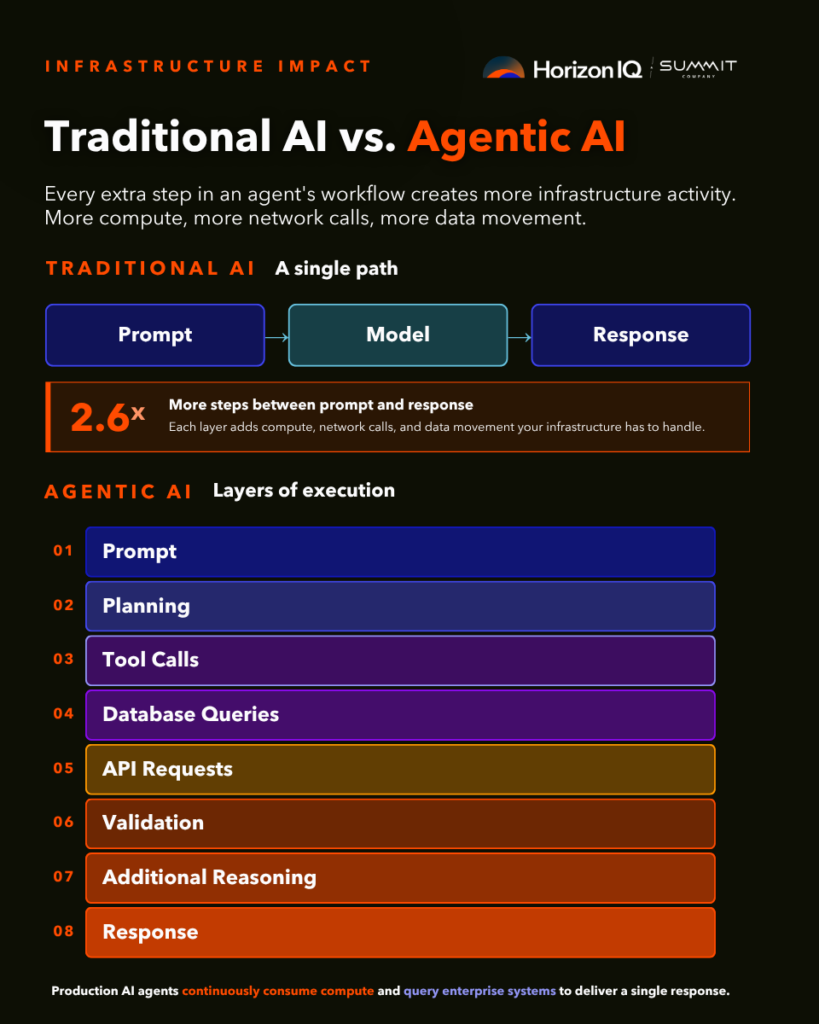
Traditional AI applications typically follow a simple path:
Prompt → Model → Response
Agentic AI introduces multiple layers of execution:
Prompt → Planning → Tool Calls → Database Queries → API Requests → Validation → Additional Reasoning → Response
Every additional step creates more infrastructure activity.
Production AI agents continuously consume compute resources, communicate across networks, access databases, authenticate with enterprise systems, and generate logs that must be monitored and secured.
As organizations deploy more AI agents across customer service, software development, finance, and operations, infrastructure becomes an increasingly important part of application performance.
AI agents spend much of their time interacting with business systems. Reliable infrastructure is essential to delivering a fast, consistent user experience.
What infrastructure challenges appear as AI applications mature?
Organizations moving from proof of concept to production typically encounter several operational challenges.
| Infrastructure Area | Early Development | Production Agentic AI |
| Compute | Small development workloads | Continuous inference serving production users |
| Storage | Model files | Vector databases, application data, logs, and backups |
| Networking | Limited API traffic | Constant communication across enterprise systems |
| Security | Developer access | User identities, agent permissions, audit trails, and compliance |
| Cost | Variable experimentation | Predictable monthly operating costs become increasingly important |
| Availability | Development uptime | Business-critical service availability |
These changes often occur gradually as AI usage expands across the organization.
When does it make sense to move Agentic AI to private infrastructure?
Public cloud remains an excellent choice for developing AI applications.
Managed AI services, flexible GPU availability, and rapid provisioning allow teams to iterate quickly while experimenting with new models and workflows.
Production introduces a different set of priorities.
As AI agents begin supporting customers, employees, or regulated business processes, organizations often evaluate whether portions of those workloads should run on dedicated infrastructure.
Common reasons include:
- Compliance and data residency requirements
- Predictable monthly infrastructure costs
- Reducing public cloud egress charges
- Consistent latency for production inference
- Dedicated GPU resources for steady workloads
- Greater operational visibility and control
This doesn’t require abandoning public cloud.
Many organizations continue building and testing new AI capabilities in hyperscale cloud environments while moving mature production workloads to private infrastructure.
Should every AI workload run in the same environment?
Usually, no. Many enterprise AI strategies are becoming hybrid by design.
| Workload | Public Cloud | Private Cloud | Hybrid Cloud |
| AI experimentation | Excellent | Limited benefit | Excellent |
| Model training | Excellent | Specialized use cases | Excellent |
| Production inference | Can become expensive at scale | Predictable performance and cost | Excellent |
| Regulated workloads | Shared responsibility | Greater operational control | Strong balance |
| Long-term cost optimization | Pay for flexibility | Pay for predictable utilization | Optimize each workload independently |
A common architecture might look like this:
- Train and experiment with new models in AWS, Azure, or Google Cloud.
- Deploy mature inference workloads on dedicated GPU infrastructure.
- Burst into public cloud when additional capacity is required.
This approach allows organizations to balance flexibility with operational efficiency.
Which Agentic AI workloads are good candidates for production infrastructure?
Many enterprise AI workloads eventually become stable, predictable services.
Examples include:
Customer support agents
Serve thousands of customer interactions every day while connecting to internal knowledge bases and CRMs.
Internal enterprise assistants
Provide employees with secure access to company documentation, policies, and operational data.
Computer vision
Continuously process video streams for manufacturing, logistics, or quality assurance.
Financial automation
Review transactions, detect anomalies, and assist with compliance workflows.
Healthcare applications
Support documentation, imaging analysis, and administrative processes while maintaining regulatory compliance.
Many of these workloads rely primarily on inference rather than large-scale model training, making them well suited for dedicated GPU infrastructure. HorizonIQ’s AI solution is optimized for production use cases including Small Language Models (SLMs), computer vision, anomaly detection, autonomous systems, and lightweight AI deployments.
Where does HorizonIQ fit into an Agentic AI strategy?
HorizonIQ isn’t designed to replace hyperscale cloud providers during AI experimentation.
Instead, HorizonIQ helps organizations optimize infrastructure as AI applications mature.
When production inference becomes a steady, business-critical workload, organizations often prioritize:
- Predictable infrastructure costs
- Dedicated GPU resources
- Compliance and data residency
- Consistent application performance
- Operational simplicity
- Expert infrastructure management
HorizonIQ’s Managed Private Cloud provides dedicated VMware or Proxmox environments with optional GPU configurations, while HorizonIQ’s bare metal GPU servers support inference-intensive applications requiring direct access to NVIDIA hardware. Teams can continue developing in public cloud while running mature production workloads on dedicated infrastructure, or combine both environments through hybrid cloud architectures. HorizonIQ manages the underlying infrastructure, monitoring, and ongoing operations so internal teams can focus on building AI applications rather than maintaining the platform.
What should organizations evaluate before moving Agentic AI into production?
Infrastructure planning becomes increasingly important as AI applications transition from prototypes to business-critical services.
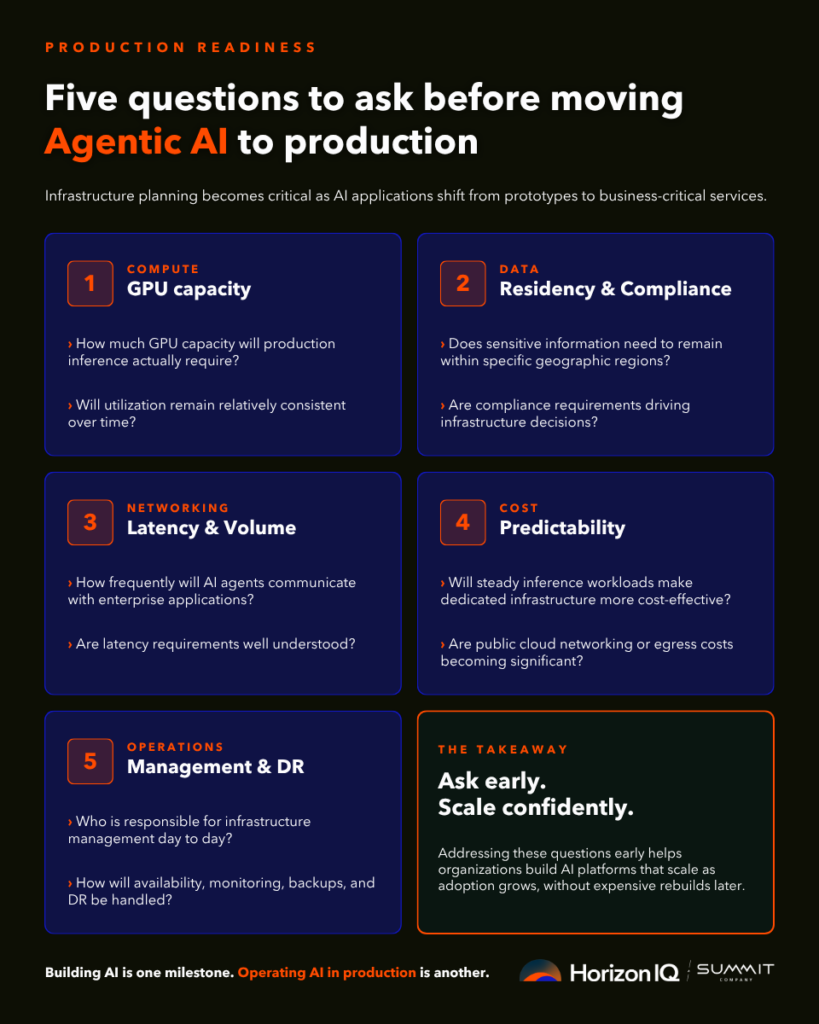
Before deploying production AI agents, consider the following questions:
Compute
- How much GPU capacity will production inference require?
- Will utilization remain relatively consistent over time?
Data
- Does sensitive information need to remain within specific geographic regions?
- Are compliance requirements driving infrastructure decisions?
Networking
- How frequently will AI agents communicate with enterprise applications?
- Are latency requirements well understood?
Cost
- Will steady inference workloads make dedicated infrastructure more cost-effective?
- Are public cloud networking or egress costs becoming significant?
Operations
- Who is responsible for infrastructure management?
- How will availability, monitoring, backups, and disaster recovery be handled?
Addressing these questions early helps organizations build AI platforms that can scale as adoption grows.
Building AI is one milestone. Operating AI is another.
Public cloud platforms have transformed how organizations build AI applications. They remain an excellent choice for experimentation, model development, and rapid innovation.
Production introduces a broader set of infrastructure considerations. As Agentic AI becomes embedded in customer experiences and business operations, organizations often seek greater cost predictability, stronger governance, and infrastructure optimized for long-running inference workloads.
For many enterprises, the goal isn’t choosing between public cloud and private cloud. It’s using each where it delivers the greatest value.
By combining the flexibility of hyperscale cloud with dedicated infrastructure for production workloads, organizations can build AI environments that scale with their business while maintaining performance, security, and operational control.